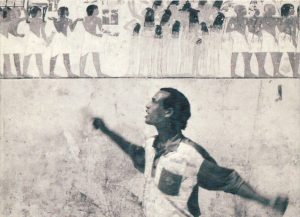
from Egyptian Fragments
Ultimately, it’s the hieroglyphs that convince me. Wherever I went I found myself admiring the cartouches containing the names of royalty, and those strips of variable geometry that are read seemingly at random, as they follow the gaze of the animals that always accompany them in stone. Right and left, up and down, then turn. Crowns, birds, serpents, hands, lions, knots, boats, chickens, crosses, geese, tools, lotus flowers, owls, vultures, horned vipers, reeds, baskets, and finally feet, spirals, eyes, bees, fish. Everything that makes Egypt what it is through its fauna, its flora, its metaphysics, its symbols, its reputation, and its singularity in the world.
My desire for Egypt did not derive from what it taught me obliquely: the existence of Rimbaud’s body. But it was in the temple of Luxor that this strange sapience was given to me, illuminated by a materialism experienced in almost mystical fashion. The light was fading, the sun was setting, and shadows had begun to mask many of the names carved in the stone throughout the last century by anonymous visitors, some of whom had accompanied Bonaparte in his campaign of conquest. I can make out an unusual “Champoléon,” the equivalent in the field of linguistics of those figures found throughout Egyptian art, which combine the body of a man with the head of an animal. This strange inscription, composed of a mixture of Champollion and Napoléon, ironically expresses the genealogy of the French passion for Egyptology.
Rimbaud. It was like a burst of light exploding in my face, a blade cutting across my eye horizontally, along the seven letters that make up his patronymic, from left to right. Never before this moment of illumination had I considered that Rimbaud might have had a body—hands, feet—or the desire to inscribe the letters of his name in the column of an ancient temple. Arthur Rimbaud, with a silhouette, a physique, flesh, bringing with him a sense of melancholy embodied in a dense materiality, that is what struck me so forcefully—like an animal battering at my forehead—whereas I had never formulated a clear idea of this dimension of his existence.
Often, I find myself reading Rimbaud when my solitude is greatest: sleepless nights, the listless hours spent in forgotten hotels, far from everything, those sunless hours that somehow anticipate a season that elicits thoughts of resurrection, following winter, or when other books fall from my hands. Naturally, I have read Alain Borer several times, following the poet to Harar or Aden, to Yemen, Abyssinia, Ethiopia, even to Java and Cyprus. I have imagined the voyager, the nomad, the wanderer, the malcontent, the man singed by his desire for the Orient, for some distant place, where the fire is violent, brutal, unyielding. I dreamed about him whenever the plane that was carrying me flew above the Red Sea, stopped briefly in Djibouti, or skirted the coast of Sudan. But there, before the graffiti in Luxor, the letters written with elegant regularity and the precision of a stone carver, I saw Rimbaud’s body in the process of carving his name.
The letters are now well above eye level, but at the time, the temple was buried in nearly three meters of sand. So, we have Rimbaud sitting on the sand, or standing, but intent, slightly stooped, attentive, scrupulous, conscientious, determined to engrave this inspired alphabet in a style both pure and simple. The asceticism of line, the quality of the engraving, its uniform depth and sacred calligraphy. Not far from the Champoléons, Thedenats, and Découtans, the name RIMBAUD, in capital letters defies the myth, overflows the fabled history and planetary delirium associated with his image, to triumph as tangible sign, as genuine trace and possible proof of the existence of a man who, at the time, had decided to have nothing more to do with the writing of poetry.
excerpt from À côté du désir d’éternité – Fragments d’Égypte (1998)
Translation by Robert Bononno (c) 2011
 Robert Bononno