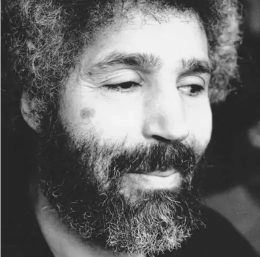
From Femmes sans visages
The man didn’t understand what was happening to him. He had been trying to recall the features of the woman who had appeared that afternoon in the valley of the pomegranate trees. He could visualize the color of her scarf, her dress, her basket, her naked body erect in the sunlight, the blue tattoo between her breasts. He could hear the woman’s song, the tinkle of her bracelets, the sound of her feet on the path. But her face was held captive by a mass of shadow that his memory was unable to penetrate.
He sat on the stone by the gate, alongside the dog. The night had lost some of its coolness. The moon, round, shone above the hillside, whose outline to the south was now visible. From time to time, he could hear a frog croak. During the silences, the man could make out the murmur of the spring in which she had bathed. He examined the small mirror found beneath the olive tree, where she had observed herself. He looked closely at the mirrored surface, which reflected a dark stain like the one that troubled his memory. Ouarda, watching her master, lifted her face. Hab Hab Roumane laughed.
“And you, dog, what do you see in this mirror?”
The concealment of the woman’s face surprised him but did not anger or upset him. He thought about the negatives he had once collected from the gutter near the photographer’s tripod. Those blurry faces eroded by the night held an endless fascination for him. He would dry them carefully, lay them out on a piece of cardboard, consider them thoughtfully. His grandmother, intrigued by his play, said to him: “Child, why are you collecting those pictures? Look! You can’t see the nose, the mouth, the eyes, the forehead, there’s nothing but black. It looks like the face of the devil or a monkey.”
He smiled. Once, he replied: “Their faces are very beautiful. You can’t see them because of the night that hides them. They haven’t been born yet; they’re waiting for their mothers to be born.”
“What are you saying, my child? And what makes you think those charcoal faces are the faces of women?”
The child knew that the photographer worked only with men. He had never seen a woman in the chair in front of the black canvas that faced the large camera set up in the middle of the sidewalk. Still, he liked to imagine women’s faces behind the curtain of shadows on the negatives that had been tossed into the gutter.
From Corps seul
1
ageless hands
rummage in my breast
exhuming from a lemon of disorder
faces houses trees
I no longer want to dream
the pools of dead cities
satisfy my thirst
2
give me a path
to the black point of my voice
give me a word like a compass needle
I seek the eye
that no eyelid limits
it knows the water that sings in the soul’s fissure
and in the sky’s charred face
3
around my throat the root has flowered once more
I thought it had been vanquished by the sands of prayer
are these petals or thorns that fall
upon the page
Translation by Robert Bononno (c) 2017
 Robert Bononno