From Esthétique du Pôle Nord
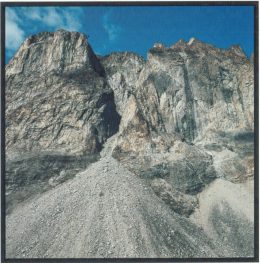
Before time, when there was no point of reference, no possibility of archeology or genealogy, there was the absolute triumph of stone. Without mankind, which made the real possible through its consciousness, geology required a time scale of unimaginable duration, the embodiment of eternity, an immortality imprisoned in hard, terrifying, and silent forms. In the silence of the movement of men or the mammals to whom they were related, the mineral imposed its cardinal and imperious law: a petrified atomism, particles imprisoned in the metal of shale or sandstone, basalt or granite.
Uncut stone was everywhere, in quantity, in number. Stones in heaps, in cones, collapsed stones, stones in blocks, fallen stones, random, immense elegant shapes that add volume to mountains, worn, tired, and exhausted stones, buffeted and made smooth through the nights and days spent washed by the motion of icy waves, pebbles of multiple dimensions, old stones whose memory has grown sluggish, sharp-edged stones recently detached from cliffs, torn from the high peaks by wind and rain, snow and ice, frost and cold, flooding and thawing.
Minerality and its rare and inhuman qualities are dominant: hardness, compactness, the pitiless edge of the razor, the sharp ridge, the cutting blade, the inhospitableness of the impenetrable. There followed the disappearance of those dangerous instruments by the work of the sea, its ebb and flow, the razor’s edge ruined by the gentle lapping of the returning tides, the soft curves acquired over an eternity of time, the eternal that has no need for the time of the gods and is measured on the scale of the infinite. Worn stones made to sit comfortably in the palm of the hand and its curled fingers so they may contain some portion of the immortality of divinities whose names remain unknown.
Translation by Robert Bononno (c) 2014
 Robert Bononno